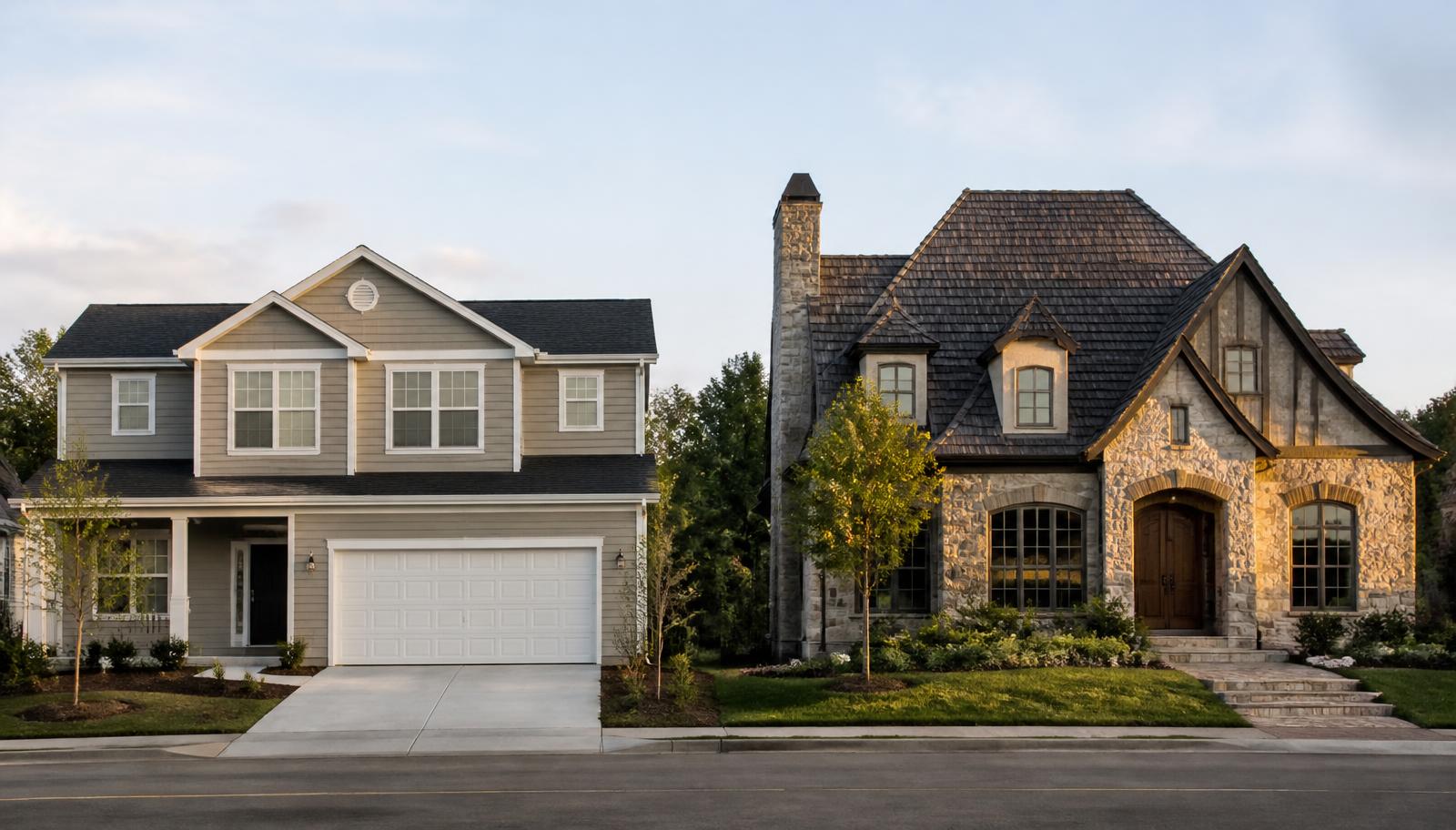
Most buyers arrive at new construction through a model home. They walk a beautiful floor plan, sit down with a sales counselor, and start talking about lots and delivery dates. What almost nobody explains in that first hour is which kind of builder they are actually sitting with.
It matters more than the finishes. The type of builder determines how the price is assembled, how much you can change, who holds the land, what the contract protects, how long the build takes, and which financing path is even available to you.
There is no better or worse here. There are two different ways of making a house, each with a buyer it suits beautifully and a buyer it frustrates.
The production builder
A production builder designs a library of floor plans and builds them repeatedly, usually inside communities they have developed and own. Efficiency is the craft. Crews know the plan, suppliers know the order, and the schedule is the product as much as the house is.
You typically buy a home rather than commission one. The builder owns the lot, the price is largely set, and you personalize within a defined menu of structural options and design center selections.
- How the price works
- A published base price for the plan, plus a lot premium, plus structural options selected before framing, plus design center selections. The total is known before you close.
- How you finance it
- Usually a normal mortgage. Conventional, FHA, VA, or USDA. Because the builder carries the construction cost, you are buying a finished home even if it does not exist yet.
- What you control
- Plan, lot, elevation, a set of structural options, and interior selections. Rarely the underlying architecture.
- Who it suits
- Buyers who want a new home with predictable cost and timing, and who like the design language the builder already builds well.
The custom builder
A custom builder starts with your land, your plan, or a plan drawn for you, and constructs a house that has never been built before in exactly that form. Judgment is the craft. The builder is coordinating architecture, engineering, site conditions, and trades against a drawing rather than a routine.
You are commissioning a house, which means you carry more of the risk and considerably more of the decision-making. You also get a home shaped precisely around how you live.
- How the price works
- A construction budget assembled from allowances and bids, plus site work, plus a contingency. It is an estimate that resolves into a final number as the house takes shape.
- How you finance it
- A construction loan. Most often a One-Time Close, where a single loan funds the build with interest-only payments on drawn funds and then converts to your permanent mortgage.
- What you control
- Nearly everything, which is both the appeal and the discipline required.
- Who it suits
- Buyers with land, an unusual site, a specific architectural intent, or requirements no catalogue plan satisfies.
Semi-custom: the space between
Most Pennsylvania builders live somewhere between the two. A semi-custom builder starts from proven plans but will move walls, change rooflines, extend a foundation, or build on land you already own.
This middle ground is where a great many buyers land, and it is also where expectations most often drift. Ask precisely which changes are routine, which require an architect, and which are simply not done. The answer is the real definition of that builder.
The useful question is never "are you a custom builder?" It is "what have you changed for a buyer in the last six months, and what did you decline to change?"
What actually changes for you
- Certainty of price
- Production: high, fixed early. Custom: resolves over time, protected by contingency and allowance discipline.
- Certainty of date
- Production: strong, though supply and inspection cycles still move dates. Custom: broader range, more dependent on weather, site, and selections.
- Financing complexity
- Production: a conventional purchase file. Custom: a construction file with draws, inspections, and builder approval.
- Where risk sits
- Production: with the builder until settlement. Custom: shared with you throughout construction.
- Design freedom
- Production: curated. Custom: near total, with the responsibility that comes with it.
How to tell which one you are in
Three questions settle it quickly. Who owns the lot right now? Is the price a published base price or an assembled budget? Will I close once, at the end, or once at the beginning with draws along the way?
If the builder owns the lot, publishes a base price, and closes at delivery, you are on the production path and you need a mortgage. If you own or are buying the land and the builder is quoting a budget, you are on the custom path and you need construction financing. Everything else follows from that.
Questions buyers ask
- Is a custom home always more expensive?
- Not necessarily per square foot, but the total is usually higher because site work, design, and one-off details cost more than repetition. Production builders buy the same materials thousands of times, and that pricing advantage is real.
- Can I use a construction loan to buy from a production builder?
- Generally no, and you usually would not want to. The builder is financing construction themselves, so you finance the purchase with a standard mortgage at delivery.
- Can a production builder build on land I already own?
- Some will, some will not, and some will only within a defined radius of their existing communities. It is worth asking early, because the answer changes which builders belong on your list.
- Which path gives me a better home?
- Neither. A well-run production build often has fewer surprises than a poorly managed custom build, and a thoughtful custom build can give you a house no catalogue could. Fit matters more than category.
Keep reading
Educational information only. Program availability, builder practices, timelines, and costs vary by builder, municipality, and market and are subject to change. This is not a commitment to lend. All buyers are subject to full underwriting and program eligibility. Corie Adams NMLS #1875205. Network Funding, LP NMLS #2297.