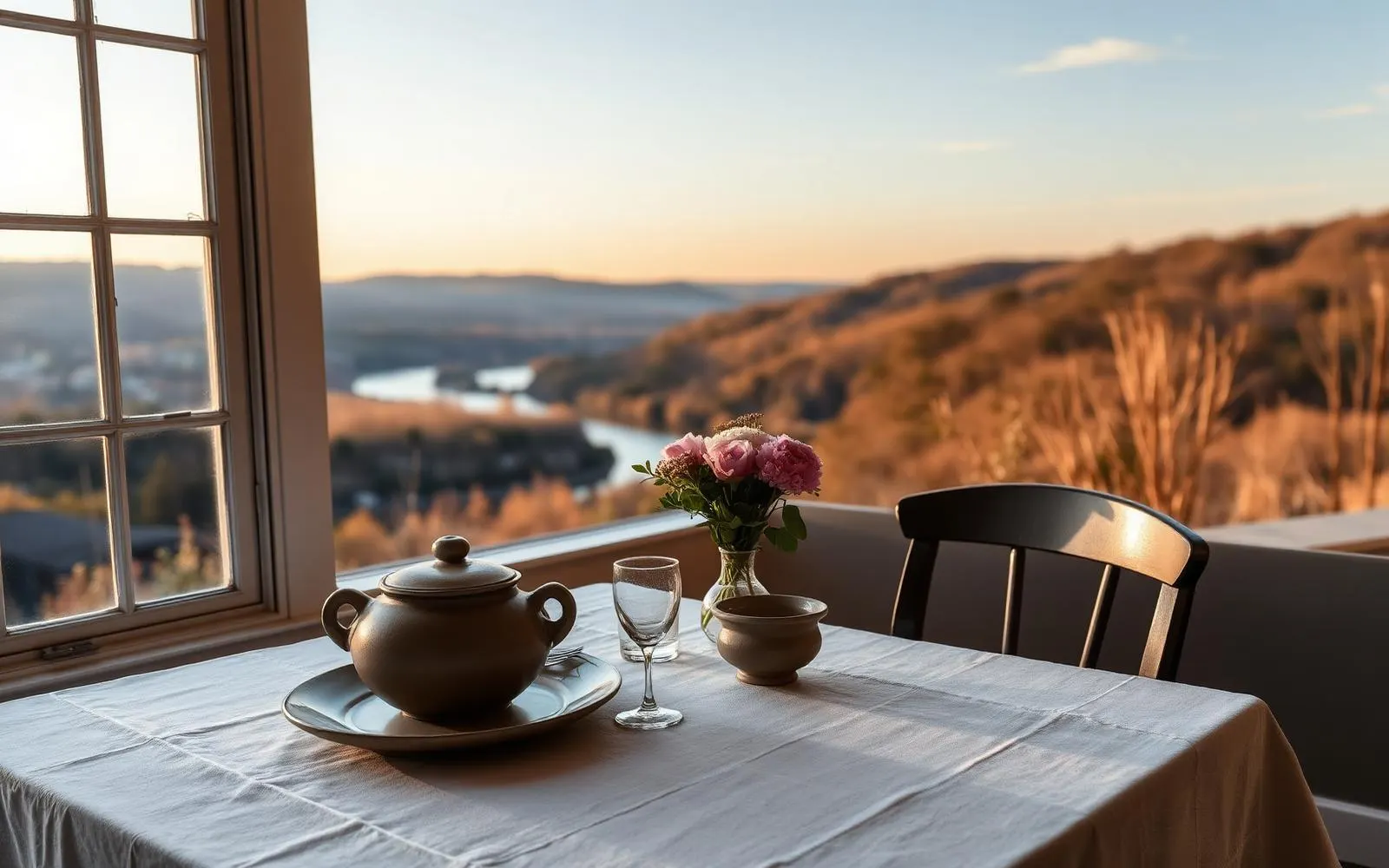
“A meaningful house is not one that is finished. It is one that is being used well.”
The Susquehanna is an old river running through a landscape that has been farmed, built on, industrialized and rebuilt for a very long time. Standing above it on a February afternoon, the thing you notice is continuity. The bends have been there far longer than any of the towns, and the towns have outlasted most of the businesses that built them.
It is a good place to think about houses, because it makes the timescale honest. Almost every house here will outlive its current owner's taste. The question worth asking is what remains valuable once the taste is gone.
Craftsmanship is a form of respect
A well made thing communicates something specific: that someone took the time. A door that closes with a satisfying weight, a stair rail worn smooth in one place, a stone wall laid by a person who cared how the courses met at the corner. None of these are luxuries in the sense of being expensive. They are luxuries in the sense of being considered.
This region has a long tradition of exactly that, in barns, in furniture, in ironwork, in quilts. What that tradition tends to value is not ornament but fitness: a thing shaped correctly for its use, made from what was at hand, built to be repaired.
Usefulness before beauty, and then beauty follows
The rooms people love in old houses are almost always rooms that did something. Kitchens, porches, workshops, back halls. The rooms that feel dead are the ones designed to be looked at: the formal living room nobody enters, the guest suite used twice a year, the outdoor kitchen four steps too far from the door.
This suggests a useful discipline when planning anything. Ask what will happen in the space on a Tuesday in March. If the answer is nothing, the space is decoration regardless of how well it is executed.

Hospitality is a design brief
A house that is good at having people in it shares a few features, and none of them is size. There is somewhere to put a coat. There is a surface near the door for the thing a guest is carrying. The kitchen has room for someone who is not cooking. The seating lets people face each other, and there is enough light to read a face.
Hospitality is mostly logistics. Warmth is easier when the coats have somewhere to go.
Houses designed for entertaining in the abstract often fail at this, because they are organized around an occasion rather than around a Tuesday evening with four people who did not plan to stay.
Natural materials, for a reason beyond taste
Wood, stone, plaster, wool, linen and clay share a property that engineered surfaces mostly lack: they improve, or at least soften, with use. A stone step hollows. A wood floor darkens where the sun falls. Linen relaxes. Brass loses its lacquer shine and becomes warm.
The practical benefit is that a house made largely of these things does not have a peak condition it can only decline from. It has a long, slow arc that most people find more beautiful at year twenty than at year one. That is a very different relationship to own a home under, and a much less anxious one.
Collected objects, and the case against a scheme
Rooms assembled all at once tend to look assembled all at once, forever. Rooms that accumulate hold a record: the chair from a family house, the bowl bought on a trip, the drawing a child made and someone framed properly.
This takes longer and requires tolerating unfinished rooms, which is genuinely uncomfortable. The compensation is that in ten years the house is unmistakably one household's and not a catalogue's, and nothing in it needs to be replaced simply because a style has moved on.
A sense of place
Finally, the strongest houses acknowledge where they are. They face the weather correctly. They use materials the region actually produces. They frame the view that exists rather than the view someone wishes existed. In this valley that might mean a window sited for the fog that fills the low ground in the morning, or a porch on the side that catches the evening.
None of this is nostalgia. It is simply the observation that a house belongs to a landscape as well as to a family, and that the ones which acknowledge both tend to be the ones people fight to keep standing.
What to take from this
- Ask what a room will be used for on an ordinary Tuesday before building it.
- Prefer materials that improve with wear over materials that only decline.
- Design for real hospitality, starting with the entry and the kitchen edge.
- Let a house accumulate rather than arrive complete.
Where to go next
The Journal is written for people thinking about homes, not just financing them. Articles are educational and reflect general observation about Pennsylvania housing, architecture, and daily life. Nothing here is an offer to lend, a commitment to a rate, or an appraisal of any particular property. Corie Adams, NMLS #1875205. Network Funding, LP, NMLS #2297. Equal Housing Opportunity.